When Does CMPA Start in Babies? Timing, Newborns and Causes
CMPA often shows up in the first weeks or months. Learn how soon symptoms can appear after milk, why breastfed babies can react and what makes it more likely.
7 min read
Written by CMPA Baby Editorial Team. Source-checked November 2026. Not a substitute for medical advice.

When does CMPA start in babies? Cow's milk protein allergy (CMPA) symptoms often begin in the early weeks and months of life.[1] How soon they show up after milk depends on the type of reaction: some appear within minutes, others take hours or a few days.[1][2] That delay is one reason the timeline can feel so confusing to parents.
This guide covers when CMPA tends to appear, how long after milk symptoms can show, whether a newborn or an exclusively breastfed baby can be affected, and what is known about causes. For the symptoms themselves, see early signs of CMPA to discuss with your doctor; for how long it lasts, see do babies outgrow CMPA?
When does CMPA start in babies?
Allergy UK notes that cow's milk allergy symptoms often start in the early weeks and months of life.[1] ESPGHAN's 2024 position paper places most cases in the first year, with proven CMPA affecting about 1% of formula-fed infants in the large EuroPrevall study.[2]
There is no fixed start date, because symptoms can only appear once a baby is exposed to cow's milk protein. That exposure can come through:
- Formula made from cow's milk, including occasional or top-up bottles.
- Breast milk, because small amounts of milk protein from the breastfeeding parent's diet can pass into it.[1]
- Solid foods containing dairy, which the NHS says can be introduced from around 6 months as part of a baby's diet.[3]
So a baby might first show symptoms in the first weeks of formula feeding, while exclusively breastfed, or later when dairy foods are offered. NICE asks clinicians to record the age at which symptoms first started and the feeding history, because together they help make sense of the timeline.[5]
How long after milk does CMPA show up?
Clinicians describe two broad patterns, and some babies have features of both.[2][5]
| Immediate (IgE-mediated) | Delayed (non-IgE-mediated) | |
|---|---|---|
| Usual timing after milk | Usually within minutes, and up to about 2 hours.[1][2] | Usually from 2 hours onward, often between 6 and 72 hours.[1][2] |
| How it can look to parents | A reaction that seems clearly linked to a particular feed. | A pattern that builds over days and is harder to connect with a single feed. |
| Which is more common | Less common. | ESPGHAN notes that most infants seen with suspected CMPA in UK data have a mild-to-moderate non-IgE presentation.[2] |
| Main safety point | Can include anaphylaxis, which is an emergency.[2][6] | Severe forms exist, such as FPIES, which can cause repeated vomiting and needs prompt medical care.[2] |
Swipe across the table to see all columns.
The NHS puts the delayed window plainly: for cow's milk allergy, it can take up to 3 days for symptoms to appear.[3] That is why "it didn't happen right after the bottle" does not rule CMPA in or out, and why "it happened after milk" does not prove it either. Many common baby symptoms, such as changes in stool or fussiness at feeds, are not diagnostic of CMPA on their own.[2] Our guide to how CMPA is diagnosed explains how a clinician puts the pieces together.
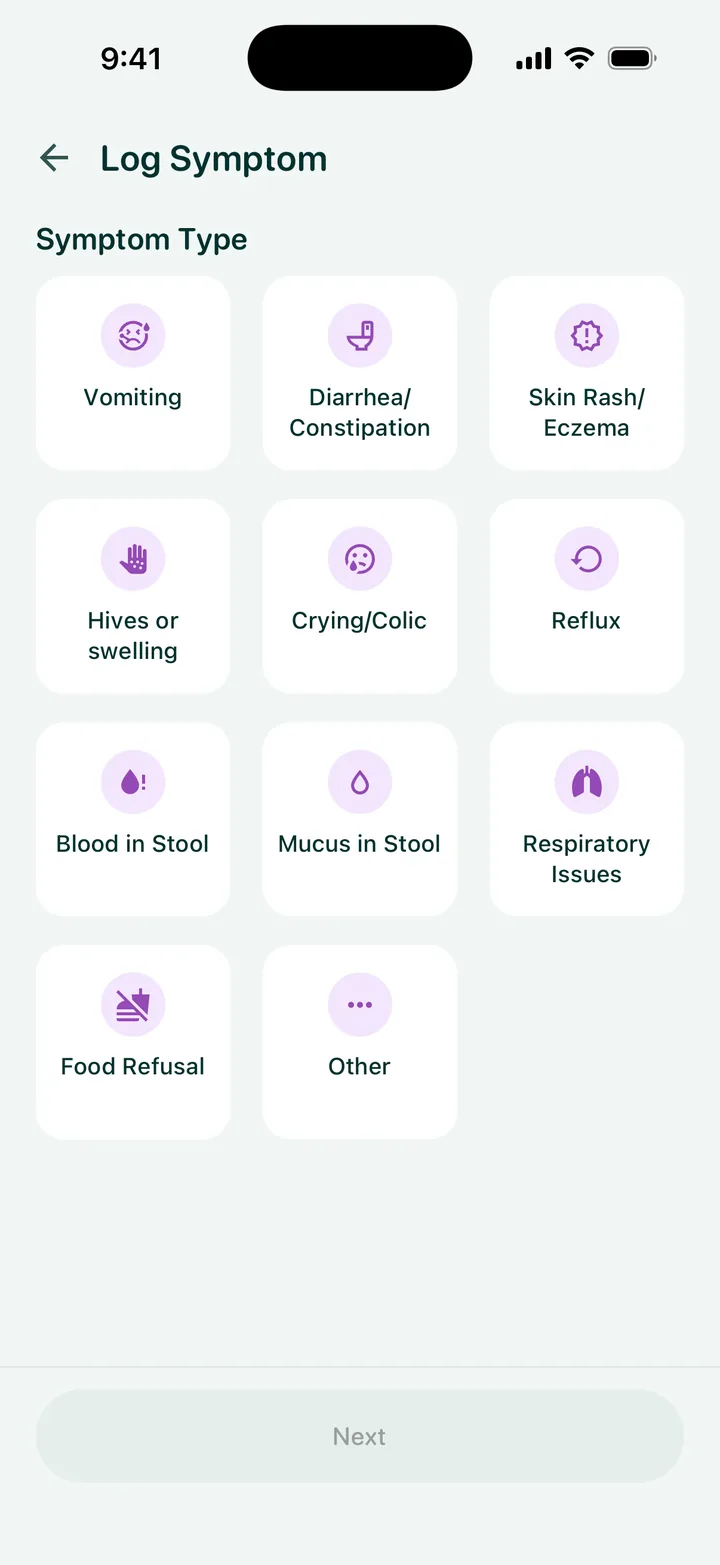
The CMPA Baby app, free on iPhone
Keep a clear timeline of feeds and symptoms
Log each feed and anything you notice with the time, then bring a dated record of when things started to your pediatrician.
Get CMPA BabyCan CMPA start in a newborn?
Yes, symptoms can appear in the early weeks of life.[1] A newborn who receives cow's-milk formula, even a few bottles, has been exposed to milk protein, and so has a breastfed baby whose parent eats dairy.[1]
Many things are common in the newborn weeks: spit-up, crying, unsettled feeds and frequent changes in stool. ESPGHAN stresses that green or mucousy stools in an otherwise healthy baby should not be treated as signs of CMPA, and that some early findings, such as a short spell of blood-streaked stools, can settle without any diet change.[2] In a newborn, a clinician will look at the whole picture, including feeding, weight and how the baby is overall. If you are weighing reflux against allergy, our guide to CMPA vs reflux covers what to describe.
Can an exclusively breastfed baby have CMPA?
It can happen, but it is uncommon. ESPGHAN reports that CMPA in exclusively breastfed infants is usually found in about 0.4% to 0.5% of babies, and warns that it is also over-diagnosed in this group.[2] When it does occur, the baby is reacting to milk protein that passes into breast milk from the parent's diet.[1]
If you are breastfeeding and worried, please don't stop or cut foods out on your own. The NHS advises against removing a major food such as milk without medical advice.[3] Any dietary change should be planned with your baby's clinician or a pediatric dietitian. Our article on breastfeeding and CMPA explains how that is usually approached.

What causes CMPA in babies, and is it genetic?
CMPA happens when the immune system overreacts to proteins in cow's milk.[4] It is not the same as lactose intolerance, which involves the milk sugar rather than the protein; see CMPA vs lactose intolerance.
Family history. Allergies tend to run in families, but it is impossible to predict whether a particular child will inherit one.[7] The NHS describes the extra chance as slight when a parent or close relative has allergies, asthma or eczema.[4] ESPGHAN notes that a sibling with allergic disease was reported to almost double the risk of food allergy, yet babies without any family history also develop allergies, and overall they outnumber those with one.[2] So CMPA is not "genetic" in the sense of a single inherited condition, and a clear family history is not needed.
Other factors. ESPGHAN lists environmental factors, such as pollution and antibiotic use early in life, as possible risk factors and describes the evidence as still developing.[2]
What did not cause it. ESPGHAN does not recommend dietary restrictions during pregnancy or breastfeeding to prevent CMPA, beyond what the parent needs for their own health.[2] Eating dairy while pregnant, choosing formula, or feeding your baby the way you did is not a mistake that caused this. No one can predict which baby will develop an allergy.[7]
Does CMPA get worse over time?
CMPA is not usually described as a condition that steadily worsens. Most children outgrow cow's milk allergy in early childhood, though in a small number it persists.[1] Our guide to outgrowing CMPA covers timelines and supervised reintroduction.
A few things can make it seem to be getting worse:
- Delayed symptoms overlap. Because they can appear up to about three days after milk, ongoing feeds can blur together into what looks like a slow build-up.[1][3]
- Immediate reactions vary. For IgE-mediated food allergy, it is impossible to predict how severe the next reaction might be, so a mild reaction does not guarantee the next one will also be mild.[7]
If symptoms are increasing, your baby is feeding less, or you are worried about weight, contact your baby's clinician rather than waiting for a pattern to become clear.
When to get help urgently
Possible anaphylaxis is an emergency. Signs can include swelling of the tongue or throat, difficulty breathing, wheezing or noisy breathing, blue, grey or pale skin or lips, or a baby becoming floppy, unusually sleepy or unresponsive. If your child has prescribed epinephrine (adrenaline), use it right away as instructed, then call emergency services: 911 in the US, 999 in the UK or your local emergency number. Call even if your baby seems to improve.[6]
Seek urgent medical advice for green or yellow vomit, blood in vomit or poo, projectile vomiting, a baby who keeps being sick and cannot keep fluids down, signs of dehydration, refusal to feed or a baby who will not stop crying and is very distressed. In the UK that means an urgent GP appointment or NHS 111; elsewhere, contact your local urgent medical service.[8]
A simple "when did it start?" record
NICE's allergy-focused history asks about the age symptoms first started, how quickly they appear after food, how long they last, how often they happen and whether they repeat on later exposure.[5] A short record like this can help you answer:
| Question | What to write |
|---|---|
| First noticed | Date and your baby's age when you first noticed the symptom. |
| Feeding at the time | Breast milk, formula (product name), mixed, or solids; the date any feeding change happened. |
| Time after the feed | Minutes, hours or the next day. Mark it "approximate" if you are unsure. |
| Duration and frequency | How long it lasted and how many times it has happened. |
| Family history | Allergies, eczema, asthma or hay fever in parents or siblings. |
| Your question | The one thing you most want the clinician to explain. |
Our symptom diary guide has a longer template, and the appointment checklist helps you prepare questions.

Talk to your child's clinician
Timing gives useful clues, but it does not diagnose CMPA. Please don't start an elimination diet, switch formula, stop breastfeeding or reintroduce milk based on a timeline alone; make those decisions with your baby's clinician or a pediatric dietitian.[3][5] If phone notes suit you, CMPA Baby helps you log feeds and symptoms with times and prepare notes for the visit; it does not diagnose or tell you what is safe.
Frequently asked questions
When does CMPA start in babies?
How long does CMPA take to show after milk?
Can a newborn or exclusively breastfed baby have CMPA?
What causes CMPA in babies, and is it genetic?
Does CMPA get worse over time?
Sources
- Cow's milk allergy. Allergy UK.
- ESPGHAN position paper on the diagnosis, management and prevention of cow's milk allergy. ESPGHAN / Journal of Pediatric Gastroenterology and Nutrition, 2024.
- Food allergies in babies and young children. NHS.
- Food allergy. NHS.
- Food allergy in under 19s: assessment and diagnosis (CG116), recommendations. NICE.
- Anaphylaxis. NHS.
- Food allergy. American College of Allergy, Asthma and Immunology (ACAAI).
- Reflux in babies. NHS.