5 Early Signs of CMPA Every Parent Should Know
Learn how to recognize early warning signs of cow's milk protein allergy (CMPA) so you can arrive prepared for your pediatric visit.
Written by CMPA Baby Editorial Team · Source-checked September 2026 · Not a substitute for medical advice.

Understanding CMPA in Infants
Cow's milk protein allergy (CMPA) is an immune reaction to the proteins in cow's milk and one of the most common food allergies in early life. How common it is depends on the population studied and on how the allergy is confirmed: US children's hospitals commonly quote around 2–2.5% of young children[1][2], and some UK charity estimates for babies under one are higher[3], but when the allergy is confirmed with a supervised food challenge the figure is lower: a large European birth cohort found challenge-proven CMPA in about 0.5% of children up to age two (about 1% in the UK)[7], and European guidance notes that CMPA is over-diagnosed more often than it is missed[5]. The challenge is that its symptoms are often non-specific and can easily be mistaken for colic, reflux, or normal newborn behavior.
CMPA symptoms can appear:
- Immediately (IgE-mediated): within minutes and up to about two hours after a feed[3], or
- Delayed (non-IgE-mediated): from a couple of hours up to about three days later[3][4]
This variability is one reason many parents experience weeks of uncertainty and trial-and-error before getting clarity. It is also why crying, spit-up, eczema or stool changes on their own are not diagnostic: they are common in babies without any allergy, and current European guidance stresses that CMPA should not be assumed from these everyday symptoms alone[5].
If your baby has trouble breathing, swelling of the lips, tongue or throat, or becomes pale, floppy or unusually sleepy after a feed, call emergency services now (911 in the US, 999 in the UK). See the emergency signs below.
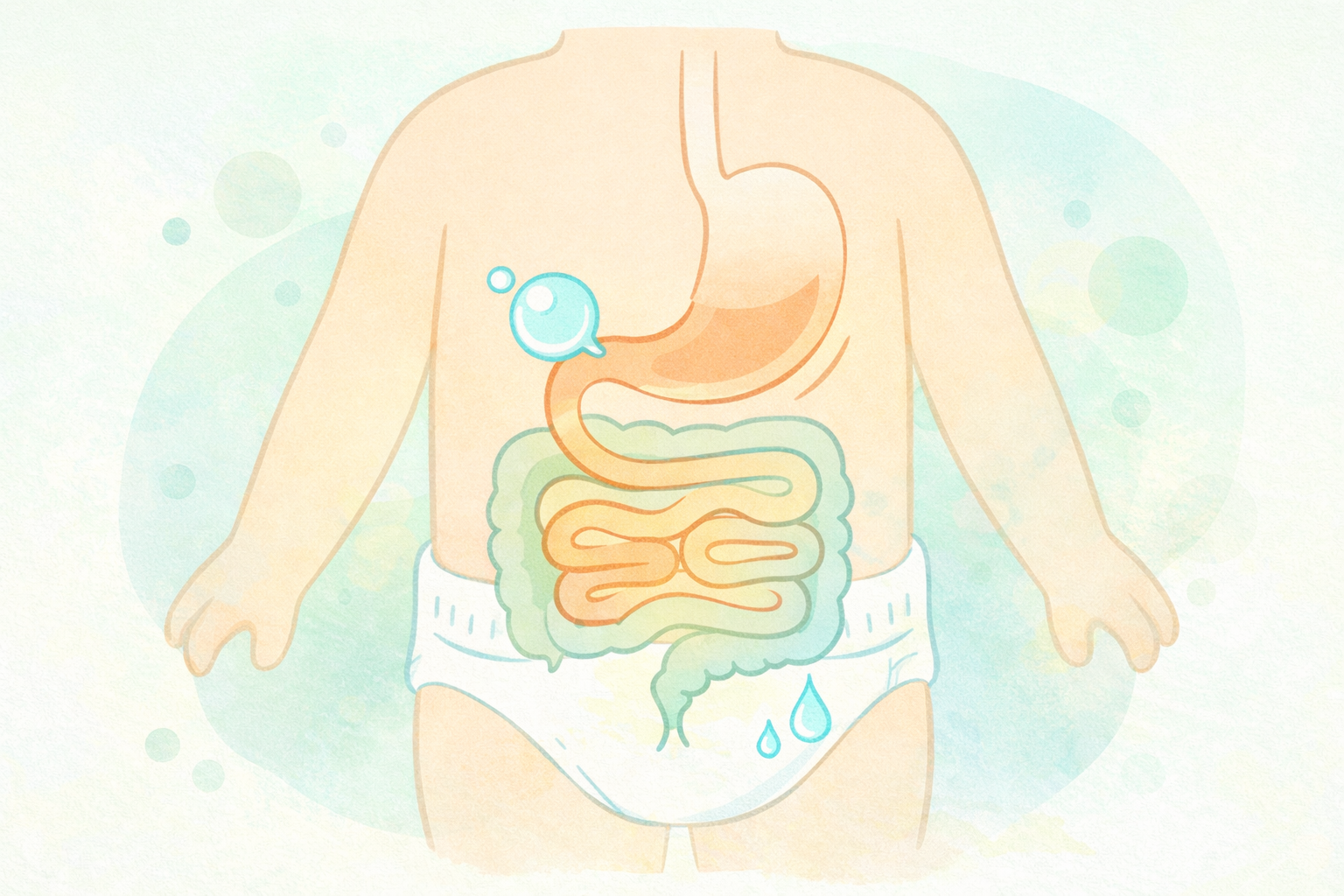
1. Gastrointestinal (GI) Symptoms
Digestive symptoms are among the most frequent signs of CMPA, affecting roughly half of babies with the allergy, about as often as skin symptoms[6].
Common GI signs include:
- Frequent vomiting or excessive spit-up, especially after feeds
- Persistent or recurrent diarrhea
- Repeated or persistent blood or mucus in the stool. An occasional spot of blood in an otherwise well baby is common and is not, on its own, a sign of CMPA[5], but any blood in the stool should always be mentioned to your clinician
- Ongoing constipation associated with discomfort or poor growth
- Abdominal pain, bloating, or distress during or after feeds
Symptoms often, though not always, begin in the first weeks after cow's milk protein is introduced, for example when a baby starts a cow's-milk-based formula. CMPA can also occur in exclusively breastfed babies, although this is uncommon and is frequently over-diagnosed, so any change to a breastfeeding parent's diet should only be made with the baby's clinician or a pediatric dietitian[5][6].
2. Skin Symptoms
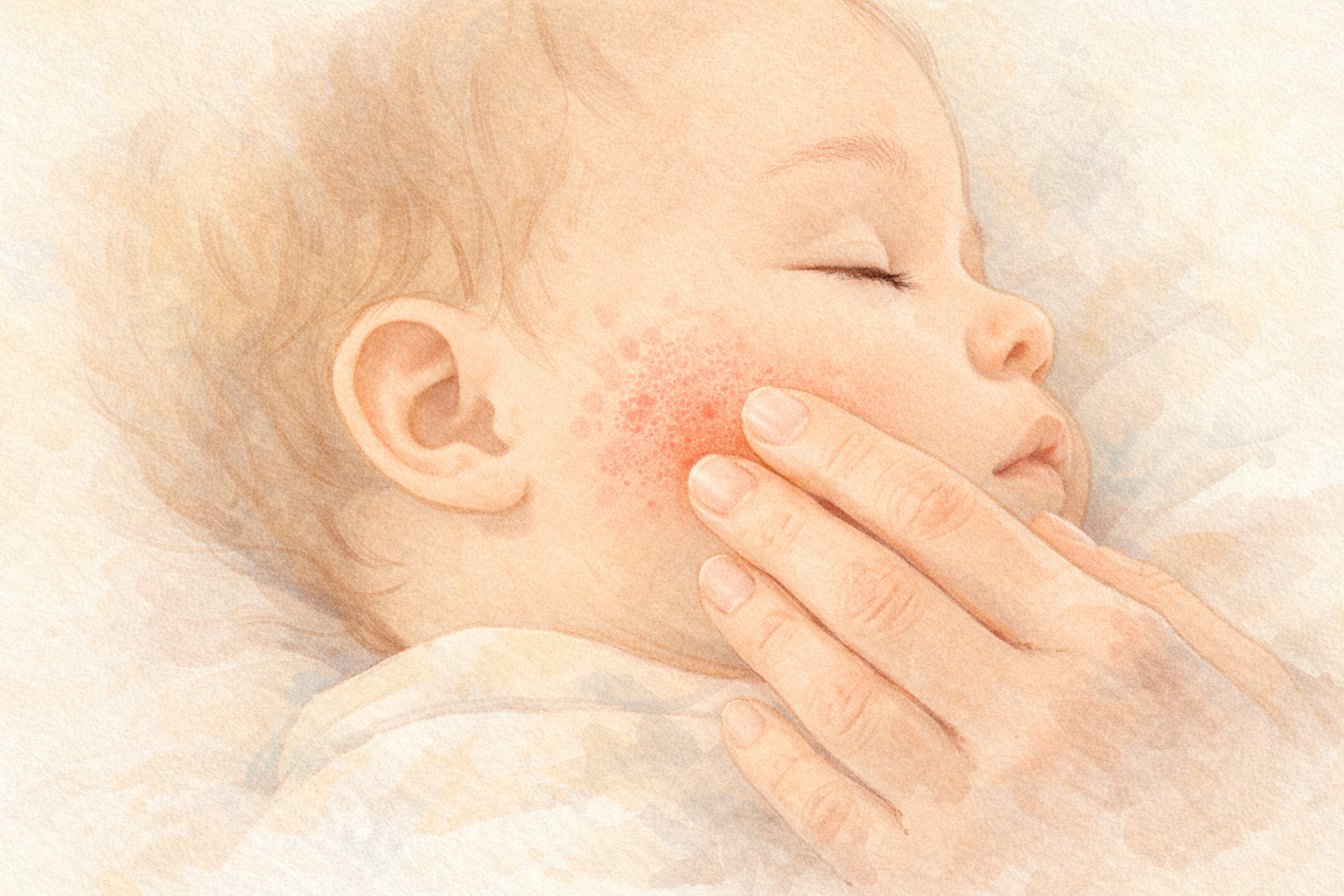
Skin involvement affects roughly half of babies with CMPA and often appears alongside digestive issues[6].
Parents may notice:
- New or worsening eczema, particularly if it flares after feeds
- Hives (raised, red, itchy welts)
- Redness or swelling of the lips, eyelids, or face
Skin symptoms can be a helpful clue when digestive symptoms alone feel ambiguous. Keep in mind that eczema is common in babies who do not have a food allergy, so it is one piece of the picture rather than proof on its own[5].
3. Respiratory and ENT Symptoms
Respiratory signs are less common (roughly one in four to one in three babies with CMPA) and usually occur alongside other allergic symptoms[6].
These may include:
- Wheezing or coughing not clearly linked to a cold
- Persistent runny or blocked nose
- Noisy breathing around feeding times
If breathing symptoms appear suddenly after milk exposure, treat it as an emergency (see the emergency signs below).
4. Growth and Overall Well-Being
Over time, CMPA can affect a baby's general well-being[6].
Possible signs include:
- Poor weight gain or falling off the growth curve
- Persistent irritability or "unsettled" behavior
- Feeding refusal or pulling away from the breast or bottle
No single symptom confirms CMPA, but patterns over time matter.

CMPA vs Colic vs Reflux: Why It's Confusing
CMPA is frequently confused with colic or reflux because they share symptoms such as:
- Crying and fussiness
- Back arching
- Spit-up
However, CMPA is more likely to also include:
- Repeated blood or mucus in stools
- Significant eczema
- Poor growth or feeding difficulties
Colic has many possible causes and only a minority of colicky babies (around one in ten formula-fed infants with colic in one review) turn out to have CMPA[6]. Only a clinician can confirm CMPA, usually through a short supervised elimination of 2–4 weeks followed by a planned reintroduction to see whether symptoms return[5][6].
When Should Parents Seek Medical Advice?
Parents are generally advised to contact their pediatrician if they notice:
- Recurrent blood or mucus in stools
- Persistent digestive symptoms
- Significant or worsening eczema
- Poor weight gain
- Ongoing distress linked to feeding
Emergency Signs: When to Call for Help Right Away
Call emergency services (911 in the US, 999 in the UK, or your local emergency number) immediately if a baby has any of the following after a feed[2][4][8]:
- Difficulty breathing, wheezing, or noisy breathing
- Swelling of the lips, tongue, face or throat
- Widespread hives together with pale skin, floppiness or unusual sleepiness
- Repeated vomiting with collapse or lethargy
If your child has been prescribed an epinephrine (adrenaline) auto-injector, use it first, then call[8]. Anaphylaxis to cow's milk is uncommon, but it is a medical emergency[2][4].
How CMPA Baby App Supports Parents (Without Diagnosing)
CMPA Baby does not diagnose or treat CMPA.
Instead, it helps parents:
- Track feeding, symptoms, and changes over time
- Organize observations clearly
- Reduce reliance on memory during stressful weeks
- Arrive at medical visits better prepared
In moments of uncertainty, structure and clarity can make a real difference. If your clinician has asked you to remove milk from a diet, our free label-reading checklist lists the names milk hides behind on packaged foods.
Key Takeaways
- CMPA symptoms can be immediate or delayed
- Digestive, skin, and growth signs often appear together
- CMPA is commonly mistaken for colic or reflux, and everyday symptoms alone are not diagnostic
- Patterns over time are more important than single symptoms
- Medical evaluation is always essential
Related reading: Breastfeeding and CMPA: what to avoid and what to know and Choosing the right formula for CMPA.
Frequently asked questions
Can a baby have CMPA with no skin symptoms?
Yes. In the guideline review cited in this article, digestive symptoms affect roughly 50–60% of babies with CMPA and skin symptoms a similar share. Many babies have both, but either can occur alone, and respiratory symptoms are less common (about 20–30%). Only a clinician can confirm the diagnosis.
Is blood in my baby's stool always CMPA?
No. European guidance (ESPGHAN 2024) says an occasional spot of blood in an otherwise well baby is common and should not, on its own, be taken as a sign of CMPA. Repeated blood or mucus in the stool, or blood together with poor growth or ongoing distress, is a reason to see your clinician, and any blood in the stool is worth mentioning at your next visit.
How soon after a feed do CMPA symptoms appear?
It depends on the type of reaction. Immediate (IgE-mediated) reactions usually start within minutes and up to about two hours after a feed. Delayed (non-IgE-mediated) reactions can take from a few hours up to about three days to appear, which is one reason CMPA is easy to mistake for colic, reflux or normal newborn behavior.
How can I tell CMPA from colic or reflux?
Often you cannot tell at home, because crying, back arching and spit-up are shared by all three. In one guideline review only around one in ten colicky formula-fed babies turned out to have CMPA. Patterns that make CMPA more likely include repeated blood or mucus in stools, significant eczema and poor growth. A clinician confirms CMPA with a short supervised elimination of 2–4 weeks followed by a planned reintroduction.
Sources
- Cow's milk protein allergy (CMPA) — Children's Hospital of Philadelphia
- Milk Allergy: Causes, Symptoms, Diagnosis & Treatment — Cleveland Clinic
- Cow's milk allergy — Allergy UK
- Food allergies in babies and young children — NHS
- An ESPGHAN Position Paper on the Diagnosis, Management, and Prevention of Cow's Milk Allergy (Vandenplas Y, et al. JPGN 2024;78:386–413) — ESPGHAN / Journal of Pediatric Gastroenterology and Nutrition (2024)
- Guidelines for the diagnosis and management of cow's milk protein allergy in infants (Vandenplas Y, et al. Arch Dis Child 2007;92:902–908) — Archives of Disease in Childhood (BMJ), via PubMed Central (2007)
- Incidence and natural history of challenge-proven cow's milk allergy in European children – EuroPrevall birth cohort (Schoemaker AA, et al. Allergy 2015;70:963–972) — Allergy (EAACI), via PubMed (2015)
- Anaphylaxis — NHS