Is There a Test for CMPA? What Allergy Tests Can and Can't Show
Skin prick and IgE blood tests help only with immediate milk allergy. Learn why delayed CMPA has no blood or stool test, and which tests guidelines reject.
7 min read
Written by CMPA Baby Editorial Team. Source-checked November 2026. Not a substitute for medical advice.

Is there a test for CMPA? Partly. For cow's milk protein allergy that causes rapid reactions, a skin prick test or a specific IgE blood test can support a diagnosis. For the more common delayed type, there is no allergy skin or blood test, and no stool test that guidelines accept.[1][3] In both types, the diagnosis rests on a clinician interpreting your baby's history, and usually on a supervised period without milk followed by milk being given back.[1][2]
This article is about the tests themselves: what each one measures and what it cannot tell you. For the whole visit, from history to follow-up, read how CMPA is diagnosed.
Why there is no single CMPA test
Cow's milk allergy is not one reaction pattern. In IgE-mediated allergy, the immune system makes IgE antibodies to milk protein, and reactions usually come quickly. Non-IgE-mediated allergy involves other parts of the immune system and usually causes delayed symptoms, often in the gut or skin.[2][3] Allergy tests detect IgE, so they can only help with the first type.
NICE tells clinicians not to carry out allergy testing without first taking an allergy-focused history, and to interpret any result in the light of that history.[2] The history decides which test, if any, makes sense. A test ordered without it can mislead in both directions.
Skin prick tests and IgE blood tests: what they can show
If the history suggests an immediate reaction, NICE recommends a skin prick test and/or a blood test for specific IgE to milk.[2] In a skin prick test, a drop of milk protein extract is placed on the skin and the skin is lightly pricked. The blood test measures IgE antibodies to milk in a blood sample. Neither involves your baby drinking milk.
What these tests can tell a clinician:
- Sensitization. A positive result shows that the immune system has made IgE to milk. ESPGHAN and iMAP both stress that this does not, on its own, confirm an allergy; the diagnosis depends on symptoms.[1][3]
- A useful negative. ESPGHAN reports that both tests are better at ruling immediate milk allergy out than ruling it in.[1]
- Likelihood, not a yes or no. Larger skin reactions and higher IgE levels make allergy more likely, but how much more depends on the child's age and the population studied.[1]
What they cannot do:
- They cannot diagnose delayed (non-IgE) CMPA. Allergy UK states that skin prick and blood tests are not helpful for the delayed type.[4]
- They are less reliable in young babies. ESPGHAN notes that young infants may at first have a negative skin test and no milk IgE, and that skin reactivity may be lower in infants.[1]
Some practical points also come from the guidance. NICE says skin prick tests should only be done where an anaphylactic reaction can be managed, by professionals trained to select, perform and interpret them.[2] ESPGHAN lists severe eczema and some medicines, including antihistamines, among the factors that can interfere with a skin test.[1] If your baby takes any medicine, mention it when the test is booked rather than stopping it yourself.
A total IgE level, the overall amount of IgE in the blood, does not contribute to diagnosing cow's milk allergy, according to ESPGHAN.[1]
The CMPA Baby app, free on iPhone
Keep the record your clinician will ask for
Log feeds and symptoms with their times in CMPA Baby, then share a clear summary at the visit. The app keeps notes; your care team interprets them.
Get CMPA BabyIs there a blood or stool test for delayed CMPA?
No. The iMAP guideline, written for delayed CMPA in infancy, says that elimination followed by reintroduction is the only reliable way to diagnose the gut forms of non-IgE milk allergy, "because there is no allergy skin or blood test for non-IgE-mediated food allergy."[3]
Stool tests are a common question, because many delayed symptoms show up in the diaper. ESPGHAN's 2024 position paper reviewed faecal markers including calprotectin, alpha-1-antitrypsin and beta defensin, and concluded they are not useful in diagnosing cow's milk allergy and are not indicated for routine diagnosis. It also says larger studies would be needed before calprotectin could be used as a marker.[1] The same paper notes that changes in stool, and occasional spots of blood in the stool, are common in babies and in general should not be considered diagnostic of CMPA on their own.[1]
That does not mean a stool sample is never taken. A clinician may still examine stools or order tests while looking for other causes. If a sample is requested, it is reasonable to ask what it is checking for. For what to note about stool changes in the meantime, see blood and mucus in baby stool.
ESPGHAN also does not recommend the atopy patch test, component testing or the basophil activation test for routine diagnosis, because the evidence for them is not yet strong enough.[1]

Tests that guidelines say not to use
Many tests are sold directly to parents, online or in clinics, as "food intolerance" or "food sensitivity" tests. NICE says not to use vega testing, applied kinesiology, hair analysis or serum-specific IgG testing to diagnose food allergy.[2] ESPGHAN adds bioresonance, iridology, cytotoxic tests and IgG or IgG4 levels to its list of approaches that are not validated.[1]
IgG panels are the most widely sold. The American Academy of Allergy, Asthma and Immunology explains that IgG to a food is likely a normal immune response to eating that food, and that higher IgG4 may simply go with tolerance.[5] ASCIA, the Australasian allergy society, strongly advises against online allergy testing and warns that unproven tests can lead to misdiagnosis, ineffective treatment and costly, often dangerous dietary restriction, or can miss a real allergy.[6]
Elimination and reintroduction: the step that confirms it
Because tests are limited, the most informative step is watching what happens without milk and then with milk again. ESPGHAN calls a challenge after a short diagnostic elimination diet of 2 to 4 weeks the cornerstone of diagnosis, and says an oral food challenge is mandatory in the work-up, except in babies with life-threatening reactions such as anaphylaxis together with high specific IgE.[1] NICE gives a range of 2 to 6 weeks for the elimination trial in delayed allergy, with advice from a dietitian on nutrition, timing and follow-up.[2]
Conceptually, this works like a test with two parts. First, milk protein is removed under a plan, and the clinician looks for clear improvement. Then milk is given back, and the clinician looks at whether symptoms return. iMAP describes the reintroduction step as "of ultimate importance to confirm the diagnosis."[3] ESPGHAN states that if the elimination does not reduce symptoms, or the challenge does not bring them back, cow's milk allergy cannot be diagnosed.[1]
Where it happens depends on the type. For suspected immediate allergy, ESPGHAN says the challenge should be supervised by trained health professionals, preferably in hospital when there has been an immediate reaction. For delayed allergy, a challenge can take place at home, but a health professional remains responsible for interpreting it.[1] A double-blind, placebo-controlled challenge is the research gold standard; in everyday practice an open challenge is usually enough.[1]
None of this is something to start on your own. Do not remove milk, change formula, alter a breastfeeding diet or give milk back to see what happens. The NHS advises parents not to experiment by cutting out a major food such as milk.[7] Ask your child's clinician or pediatric dietitian for a written plan with dates and a named person to contact.
Comparing CMPA tests
| Test | When it may be used | What it can show | Main limit |
|---|---|---|---|
| Skin prick test | Suspected immediate (IgE) reactions | Sensitization to milk[1][2] | Positive does not prove allergy; less reliable in young infants[1] |
| Specific IgE blood test | Suspected immediate (IgE) reactions | Sensitization to milk[1][2] | Not helpful for delayed CMPA[3][4] |
| Total IgE | Not for diagnosis | Overall IgE level only | Does not contribute to diagnosing CMPA[1] |
| Stool markers (such as calprotectin) | Not for routine diagnosis | Not useful for CMPA[1] | Evidence insufficient[1] |
| IgG panels, hair analysis, kinesiology, vega | Not recommended | Nothing validated[1][2][5] | Risk of misdiagnosis and needless restriction[6] |
| Supervised elimination, then reintroduction or oral food challenge | Both types, planned by a clinician | Confirms or rules out CMPA[1][3] | Needs a plan, dietitian support and clinical interpretation[1][2] |
Swipe across the table to see all columns.

Questions to ask about any test
- Which type of reaction are you considering? The answer determines whether an IgE test makes sense at all.
- What will a positive or negative result change? Ask how the result fits with the history.
- Who will interpret it, and when? Results need a clinician, not a lab printout alone.
- If an elimination trial is planned, what is the date for reintroduction or a challenge? Ask for it in writing.
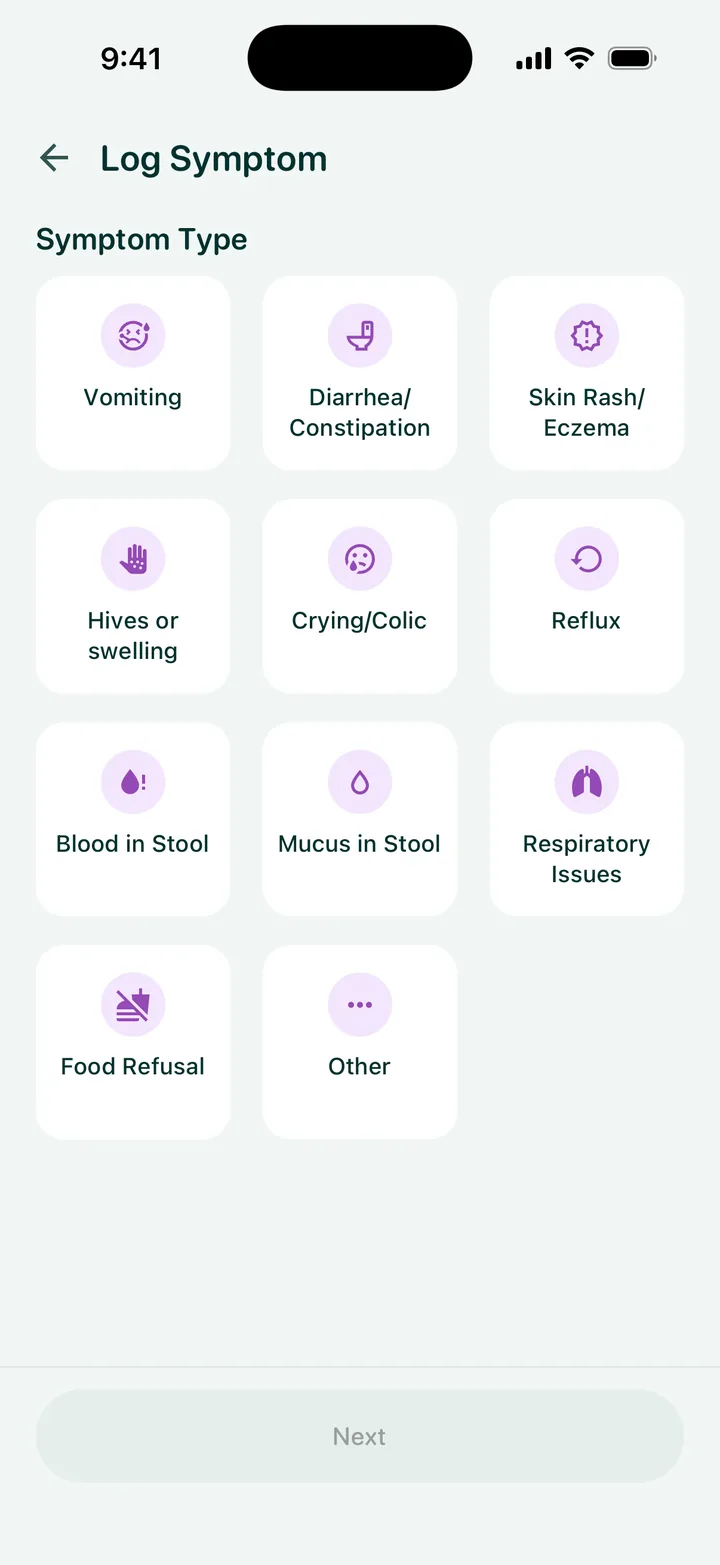
Our pediatrician appointment checklist helps you gather records, and the symptom diary guide shows how to log feeds and symptoms with times, which is the information an allergy-focused history depends on.[2] If you prefer your phone, CMPA Baby helps you log meals and symptoms and prepare notes for the visit; it does not test for or diagnose CMPA.
When it is an emergency
Possible anaphylaxis needs immediate help. Signs include swelling of the tongue or throat, difficulty breathing or very fast breathing, wheezing or noisy breathing, difficulty swallowing, blue, grey or pale skin or lips, or a baby who becomes floppy, limp or unresponsive. Use prescribed epinephrine (adrenaline) straight away if you have it, then call emergency services: 911 in the US, 999 in the UK or your local number. Say you think it is anaphylaxis, and call even if your baby seems to improve.[8] Do not wait for a test result or try to record the reaction first.
Frequently asked questions
Is there a test for CMPA?
There is no single test. Skin prick and specific IgE blood tests can support a diagnosis of immediate (IgE-mediated) milk allergy, but a positive result shows sensitization rather than proof. For delayed CMPA, diagnosis relies on a clinician-supervised elimination followed by reintroduction or an oral food challenge.
How do they test for CMPA in babies?
A clinician starts with an allergy-focused history and examination. If immediate reactions are suspected, they may arrange a skin prick or IgE blood test; for delayed symptoms, they plan a trial without milk protein and then a planned return of milk to see whether symptoms come back. Parents should not run this trial on their own.
Is there a blood test for CMPA?
Only for the immediate type. A specific IgE blood test can show sensitization to milk, which a clinician interprets with the history. There is no blood test for delayed (non-IgE) CMPA, and total IgE or IgG food panels are not useful for diagnosis.
Is there a stool test for CMPA?
No stool test confirms CMPA. ESPGHAN's 2024 position paper says faecal markers such as calprotectin are not useful for diagnosing cow's milk allergy, and that occasional spots of blood in stool are common and not diagnostic on their own. A clinician may still request a sample for other reasons.
Are home or online food intolerance tests reliable for CMPA?
No. NICE advises against IgG testing, hair analysis, kinesiology and vega testing for food allergy, and ASCIA warns that online allergy tests can lead to misdiagnosis and unnecessary, sometimes harmful, dietary restriction. Bring your concerns to your child's clinician instead.
Sources
- ESPGHAN position paper on the diagnosis, management and prevention of cow's milk allergy (Vandenplas et al., JPGN 2024;78:386-413). ESPGHAN / Journal of Pediatric Gastroenterology and Nutrition, 2024.
- Food allergy in under 19s: assessment and diagnosis (CG116), recommendations. NICE.
- iMAP guideline for non-IgE-mediated cow's milk allergy in infancy (Venter et al., Clin Transl Allergy 2017). Clinical and Translational Allergy (PMC), 2017.
- Cow's milk allergy. Allergy UK.
- The myth of IgG food panel testing. American Academy of Allergy, Asthma and Immunology.
- Evidence-based versus non evidence-based tests and treatments for allergic disorders. ASCIA (Australasian Society of Clinical Immunology and Allergy).
- Food allergies in babies and young children. NHS, 2024.
- Anaphylaxis. NHS, 2023.