FPIES vs CMPA: How This Delayed Milk Reaction Differs
FPIES is a delayed, non-IgE reaction with repeated vomiting hours after a trigger food. See how it differs from other milk allergy types and when to get help.
7 min read
Written by CMPA Baby Editorial Team. Source-checked November 2026. Not a substitute for medical advice.

If a clinician has mentioned FPIES, or you have seen it in a forum thread about milk allergy, you may be wondering how FPIES vs CMPA fits together. Food protein-induced enterocolitis syndrome (FPIES) is a delayed, non-IgE food allergy that mainly affects the gut, and cow's milk is one of its most commonly reported triggers.[1][2] So when milk is the trigger, FPIES is one specific form of cow's milk protein allergy (CMPA), with its own pattern, its own diagnostic criteria and its own emergency plan.[1][2]
This guide explains what FPIES is, how it differs from allergic proctocolitis and from the quicker IgE-mediated type, and what to do if a baby becomes unwell. It is not a way to work out at home which one your baby has: that needs a clinician who knows your child.
What is FPIES?
The international consensus guidelines describe FPIES as a non-IgE, cell-mediated food allergy that typically starts in infancy. In an acute reaction, repetitive, protracted vomiting begins approximately 1 to 4 hours after the food is eaten. The vomiting is often accompanied by lethargy and pallor and can be followed by diarrhoea, which in some cases develops 5 to 10 hours after the food.[1] Rashes and breathing problems are not usually part of an FPIES reaction.[4]
Most reactions settle within about 24 hours, and most children with acute FPIES are well between episodes and grow normally.[1] Severe reactions can progress to dehydration, low blood pressure and low body temperature, and can resemble sepsis; the guidelines report hypotension in at least 15% of reactions.[1]
There is also a less common chronic form, reported almost only in infants younger than 4 months who are fed cow's milk or soy formula every day. It shows up as on-and-off vomiting, watery diarrhoea and poor weight gain rather than a single dramatic episode.[1][2]
FPIES milk triggers and other foods
ESPGHAN lists cow's milk as one of the most commonly reported FPIES triggers.[2] The consensus guidelines name milk, soy and grains as the most common, with rice and oat the most frequently reported solid-food triggers; the pattern varies between countries, and a child can have one trigger or several.[1] Milk- and soy-triggered FPIES tends to start earlier, often before 6 months, because those foods are usually introduced first.[1]
The guidelines also note that most infants do not react to food proteins passed through breast milk.[1] Any decision about breastfeeding, formula or the foods a baby eats belongs with your child's allergy team or pediatric dietitian.
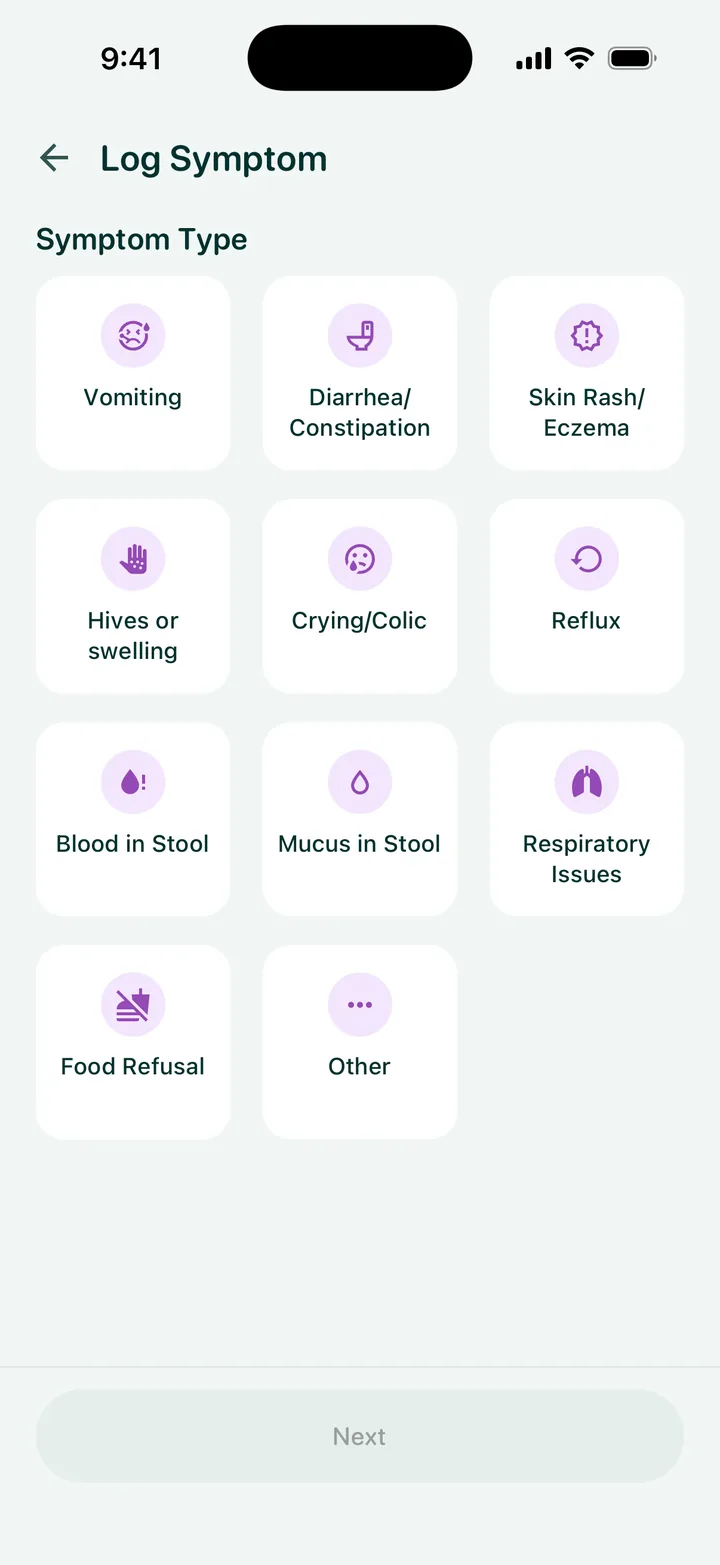
The CMPA Baby app, free on iPhone
Keep the timeline your allergy team asks for
Log meals and symptoms with their times in under a minute, then bring a clear record to your child's next appointment.
Get CMPA BabyFPIES vs CMPA: where it sits among milk allergy types
CMPA is an umbrella term. ESPGHAN separates IgE-mediated reactions, which usually start within minutes, from non-IgE reactions, which are delayed, typically starting 2 or more hours after milk and often between 6 and 72 hours. The non-IgE group ranges from mild rectal bleeding in allergic proctocolitis to the severe vomiting and sepsis-like picture that can occur in FPIES.[2] If the abbreviations are confusing, our guide to CMPA, CMA, CMPI and MSPI explains them.
FPIES vs allergic proctocolitis (FPIAP)
Food protein-induced allergic proctocolitis is also non-IgE, but it looks very different. ESPGHAN describes it as blood and mucus-streaked stools in otherwise healthy young infants, occurring mostly in breastfed babies, usually starting in the first weeks of life and settling in late infancy. It is generally benign and self-limiting.[2] There is no repeated vomiting or collapse as in FPIES. If stool changes are your main concern, read blood and mucus in baby stool; blood in a stool still needs to be reported to a clinician.
FPIES vs IgE-mediated milk allergy
IgE-mediated reactions usually start quickly, typically within minutes of the food and sometimes up to 2 hours later, with signs such as an itchy rash, swollen lips or face, or vomiting; anaphylaxis is the most severe form.[2][7] Vomiting can happen in both. The consensus guidelines point out that the delayed onset and the absence of skin and breathing symptoms suggest FPIES is a different kind of reaction from anaphylaxis.[1] A small number of children have both features: some have IgE to the trigger food, which the guidelines call atypical FPIES.[1][3]
| Feature | Acute FPIES | Allergic proctocolitis (FPIAP) | IgE-mediated milk allergy |
|---|---|---|---|
| Immune type | Non-IgE[1] | Non-IgE[2] | IgE antibodies[2] |
| Usual timing | Vomiting about 1 to 4 hours after the food[1] | Ongoing, in the first weeks or months of life[2] | Minutes, sometimes up to 2 hours[7] |
| Typical picture | Repeated vomiting, pallor, lethargy, sometimes later diarrhoea[1] | Blood or mucus-streaked stools in a baby who is otherwise well[2] | Itchy rash, swelling of lips or face, vomiting; possible anaphylaxis[7][8] |
| Allergy tests | Skin prick and IgE tests are usually negative; diagnosis rests on history[1] | Assessed by a clinician; ESPGHAN describes it as usually benign[2] | Skin prick or IgE blood tests can help, interpreted by a clinician[2] |
| Emergency treatment | Fluids and medical care; epinephrine is not the routine treatment[1][5] | Not usually an emergency, but report blood in stool[2] | Prescribed epinephrine (adrenaline) and emergency services[8] |
Swipe across the table to see all columns.
The table summarises typical patterns described in guidelines. Real babies do not always follow them, and a pattern on paper does not diagnose your child.[2]
FPIES symptoms in a baby: when to get urgent help
Call emergency services (911 in the US, 999 in the UK or your local number) if your baby is vomiting repeatedly and becomes pale, floppy, very sleepy, hard to wake, or has cold, pale, grey or blotchy skin. These can be signs of severe dehydration or shock, and the consensus guidelines treat acute FPIES as a medical emergency.[1][9] Do not wait to see whether it is FPIES, a stomach bug or something else; that is for the medical team to work out.
Seek urgent advice the same day for signs of dehydration such as fewer wet diapers, few or no tears, a sunken soft spot or unusual drowsiness or irritability.[9]
Why epinephrine is not the FPIES treatment. FPIES is not anaphylaxis. Hospital care focuses on fluids, often through a drip, and anti-sickness medicine; the guidelines say epinephrine auto-injectors are not routinely prescribed for FPIES, and ASCIA states that adrenaline injectors and antihistamines do not play a role in its management.[1][3][5] That does not make an episode less serious: it means the help a baby needs is medical care, quickly. If your child has a written FPIES plan from their clinician, follow it.[1][5]
Possible anaphylaxis is a different emergency. Sudden swelling of the tongue or throat, noisy or difficult breathing, a hoarse cry, blue, grey or pale lips, or a baby becoming limp or unresponsive can be signs. Use prescribed epinephrine (adrenaline) immediately as instructed, then call 911, 999 or your local emergency number, even if your baby seems to improve.[8] Children who have both FPIES and an IgE-mediated allergy may be prescribed an auto-injector for that reason.[1]

How FPIES is diagnosed
There is no single test for FPIES. Diagnosis is based mainly on a careful history of typical signs and improvement after the suspected trigger is removed, with other causes ruled out; a medically supervised oral food challenge may be used when the history is unclear.[1][2] Most children with FPIES have negative skin prick tests and no detectable IgE to the food, which is why a normal allergy test does not rule it out.[1][6] Because a severe episode can look like a stomach infection or sepsis, the timing details you remember matter.[1]
Clinicians asking about a possible episode usually want specifics like these:
| Detail | What to record |
|---|---|
| The food | What your baby had, including the exact formula or new solid food, and the time. |
| First vomit | Time it started, number of vomits and roughly over how long. |
| How your baby looked | Colour, alertness, floppiness, and any diarrhoea and when it began. |
| Care received | Where your baby was seen, what treatment was given and the discharge advice. |
| Earlier exposures | Whether your baby had that food before, and what happened then. |
Write these down after your baby has been assessed, never instead of getting help. Our CMPA vs reflux guide covers how to describe vomiting and spit-up more generally, and how CMPA is diagnosed explains supervised elimination and challenges.

Do children outgrow FPIES?
Many do, but timing varies widely between studies and countries. In one large Israeli cohort with milk-triggered FPIES, 60% tolerated milk by age 1 and 85% by age 3, whereas a large US case series reported a median age of resolution of about 5 years.[1] Whether FPIES has resolved is usually checked with a supervised food challenge; ESPGHAN notes this may be done 12 to 18 months after the last reaction, although there is no consensus on exact timing.[2] Reintroducing a trigger food at home is not something to try on your own.
Working with your child's care team
If FPIES has been diagnosed or suspected, ask your child's clinician for a written emergency plan that names the trigger foods, what to do in a mild reaction and when to call for help.[1][5] Ask a pediatric dietitian how to keep your baby's diet nutritionally complete, especially around starting solids. If you like keeping records on your phone, CMPA Baby helps you log meals and symptoms with their times and prepare notes for the next visit; it does not diagnose FPIES or tell you which foods are safe.
Frequently asked questions
What is FPIES?
What is the difference between FPIES and CMPA?
Is milk a common FPIES trigger?
What are FPIES symptoms in a baby?
Is FPIES anaphylaxis, and is an EpiPen used?
Do babies outgrow FPIES?
Sources
- International consensus guidelines for the diagnosis and management of food protein-induced enterocolitis syndrome (Nowak-Wegrzyn et al., JACI 2017). American Academy of Allergy, Asthma & Immunology, 2017.
- ESPGHAN position paper on the diagnosis, management and prevention of cow's milk allergy (Vandenplas et al., JPGN 2024). ESPGHAN / Journal of Pediatric Gastroenterology and Nutrition, 2024.
- Food protein-induced enterocolitis syndrome (FPIES). American Academy of Allergy, Asthma & Immunology.
- Food protein-induced enterocolitis syndrome (FPIES). Food Allergy Research & Education (FARE).
- Action Plan for FPIES. Australasian Society of Clinical Immunology and Allergy (ASCIA).
- FPIES (Food Protein Induced Enterocolitis Syndrome). Allergy UK.
- Food allergies in babies and young children. NHS.
- Anaphylaxis. NHS.
- Dehydration. NHS.